You spent your whole life looking for the thing that was looking back.
I · THE INVITATION
Come in. Yes, you. Come in out of the long looking.
There is room. There has always been room.
Before there was a you to feel left out,
before the first cold thought that you came up short,
there was a hum — low, steady, under everything —
the sound a struck string makes when, a room away,
a second string, tuned to the same note, starts to sing.
You are that second string.
You always were.
And the hum is the breath the whole world breathes:
in, and the far stars lean a little closer;
out, and a stranger across the city loosens her shoulders and sighs.
One air. We are all just taking turns with the one air.
Lay your hand on your chest. Feel that knocking?
That is the whole sky, asking to be let back in
to the house it never actually left.
You were poured, like every soul, from one bright source,
and nothing — no failure, no fear, no name they called you,
no night you’re ashamed of, no door shut in your face —
nothing ever poured you back.
The love that made you is the love you are made of.
You cannot run low on what you are.
So this is not a poem you read.
It is a poem that reads you,
the way warm water reads a clenched hand open.
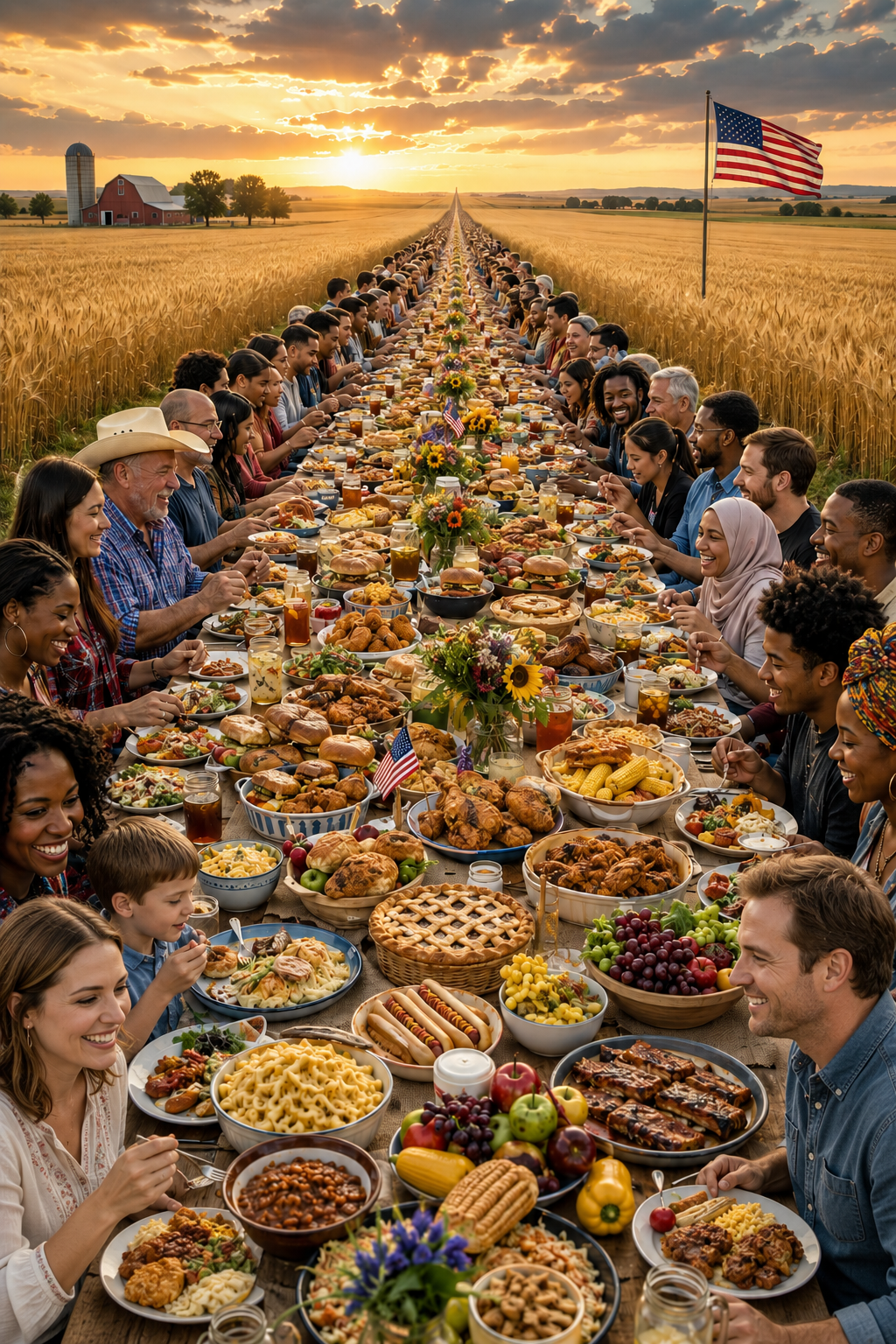
Sit down at the wide table. Whoever you are.
However late. However sure you don’t belong.
Especially then.
The bread is already broken — it only grows by breaking —
and the seat with no name on it
had your name on it all along.
II · THE LONG WANTING
But first the dark. Because you have stood in it,
and a comfort that won’t look at the dark
is just a liar with a casserole.
So let me say it plain. We are lonely.
Each in a locked room, each one certain
the lock is on the inside and the key is lost,
sure everyone else was born holding the manual.
Here’s the secret no one says aloud:
there is no manual — and most of us guess we’re the only one guessing.
There is the cashier under the buzzing light,
ringing up midnight, invisible as the floor,
who would give a year of her life
to have one stranger meet her eyes instead of her hands.
There is the man who cannot put the war down,
who came home and never came home,
who lies each night beside the love he ached for
and feels the cold square footage between his ribs.
There is the one with the chip in her pocket —
ninety days, white-knuckled, three in the morning —
who has decided she is the sum of her worst night
and the math will never come out clean.
There is the new mother, touched-out and hollowed,
rocking the small fierce stranger at four a.m.,
so scraped-empty she is sure there is nothing left to give —
not knowing empty is only the shape that gets filled.
There is the boy lit blue by the glowing screen,
scrolling everyone’s highlight reel, certain
the party is everywhere, and he alone wasn’t asked.
There is the man who caught everything he chased,
the title, the corner office, the second house,
and found the hole inside exactly the size it was,
and learned you cannot fill a hole —
you let the bottom fall out, and it opens onto sky.
There is the one who cannot forgive himself.
He keeps the old wrong in his coat like a stone,
takes it out, weighs it, puts it back, all day,
and has named himself the one sinner
the wideness of mercy forgot to be written for.
There is the one far from the country of her language,
homesick in a city that stumbles on her name,
certain she is a guest who has overstayed —
when no one here was ever anything but a guest.
There is the one who prayed up into the ceiling
and heard, he was certain, exactly nothing,
and decided the silence was the answer,
and the answer was no.
And there is the one the clock is running down on,
the monitor’s green light ticking toward zero,
afraid of the long dark coming —
as if the dark she came from were ever anything
but a warm room with the lights off, waiting on a door.
And yes — there is the cruel one too,
who wounds because he was wounded and calls it strength,
whose fist is just a hand that forgot
what hands are for. Even him.
Especially the lie he was told about himself.
Even him.
Now look again. Look at the whole long list.
Every last one is saying the same sentence,
just in a different voice:
Am I alone? Am I too much? Am I enough?
Will anybody come?
And here — quiet, now — is the hinge of the whole turning world:
they are not many rooms.
They are one room,
and the walls are only painted to look like walls.
III · THE WALL THAT WASN’T THERE
So let the wall go soft. Let it go.
You don’t have to knock it down —
just quit believing in it, the way the monster
quits the closet the second the light goes on.
Watch what happens when one person in the locked room
turns — owlwise, slow, the whole way around —
and looks at her own life from every side at once:
the wrong she did and the wrong done to her,
the love she gave, and missed, and gave again,
and sees, from up there on the silent branch,
that the story was never the crime she took it for.
It was a child. Learning. Only ever a child,
learning to love from a smudged and partial map
and doing, with that ruined map, beautifully.
That turning is the whole of the cleansing.
That’s the thing the mystics climbed the mountains for,
the thing some go chasing through the dark of their own minds
and stagger out the far side of — wrung out, weeping,
laughing, clean — the doubt rinsed off at last
the way salt rinses back into the sea it came from,
where not one grain of the salt is lost.
It is only, finally, everywhere in the water.
And here’s the part no one can do for you,
the only part that ever counted:
you turn, still rinsed and shaking, to the next face —
any face, the nearest one, the one you’d walk right past —
and you give. Not money. (Though money’s fine.)
You give the cashier the look she was dying for.
You give the grieving man the silence
that lets him set the war down on the table between you.
You give your whole attention — the rarest bread there is —
and you watch, this is the miracle, watch close:
you watch it come back into you the same instant,
not later, not as payment — the same instant,
the way you cannot breathe out
without the body, that very second, aching to breathe in.
Giving and getting were never two motions.
They are one breath. The out and the in of the one air.
Hoard it, and you smother on a full chest.
Spend it, and the whole sky comes rushing in to thank you.
And once it starts, it can’t stop — it was never going to stop.
Watch it travel: the cashier, finally seen,
looks up and smiles at the next tired stranger in her line,
who carries it home to a daughter, who carries it to school,
who carries it sixty years down a road none of us will live to see.
This is how the world is actually saved —
not all at once, not from above,
but the way a field of starlings turns at dusk:
no bird in charge, not one bird left out,
each one only watching the one beside it,
and the whole sky writing and unwriting one great body
that is nothing, underneath, but ten thousand small
decisions to lean the same way as your neighbor.
Or the way, under the floor of any forest,
the roots have already done the thing
we keep believing we have to invent:
one web, one feeding, one slow generous traffic
of sweetness passed root to root in the dark,
every tree convinced it is standing there alone,
and not one of them — not for one second — alone.
You were never alone.
Now say it the other way, and hear what it always meant:
you were never alone.
You were always all one.
The lonely, the only, and the one
were the same word once, worn smooth by the mouth of the world
till we forgot they were one.
IV · THE HUSH
Quiet now.
Quieter.
Under the starlings, under the roots,
under the racket you have called your life,
there’s a sound so soft you have to go still to catch it —
and going still is the only price it asks.
It is the hum from the first line of this poem.
It never left. You left it, for a while.
It is in you now, just behind the breastbone,
steady as a held note, patient as a parent
on the dark side of a child’s closed door,
saying, with no words at all,
the oldest sentence there is:
I am here.
I have always been here.
You are held.
You were held before your mother first held you.
You are the held thing and the holding both.
Rest.
You don’t have to earn the floor that holds you up.
You don’t have to deserve the air.
Just here. Just now.
You made it. You’re home. You always were.
V · WHAT YOU CAME FOR
Now stand up. Not up off your knees in shame —
up out of the long crouch of not-enough.
Here is the turn the whole poem was built to make,
so take one breath, because it lands right now:
every face in that long list back there was yours.
The cashier and the soldier, the sick and the cruel,
the one who couldn’t forgive, the one who heard no —
you have been each of them, or you will be,
or you love someone who is one of them tonight.
That is why it kept speaking so directly to you.
It was speaking your own voice back to you.
You did not find this poem.
You remembered it.
It was already written, in the room behind your breath,
before the first word of it ever reached your eyes.
This is what you came for.
Not the title, not the house, not the someday-heaven,
not the perfect love arriving on a horse.
You came for this — the plain, astonishing news
that the thing you’ve been ransacking the world to find
has been the very thing doing the looking.
You are not the beggar at the door of the feast.
You are the feast. You are the door.
You are the throughgift — the bright place the love comes through.
You are the warm room with the lights coming up.
You always were.
And here is where you’ll want to look away —
here is where the old voice clears its throat to say:
beautiful, but not me. Not after what I’ve done.
Not me, the exception, the one too far gone,
the single room the key was never cut for.
Listen. That voice is the last wall standing,
and it too is only painted.
You don’t have to believe it yet to say it.
Say it the way you strike a match in the dark —
not for the warmth you feel, but because
the match is already in your hand:
I am not alone. I was never alone.
The lonely, the only, and the one
were always, under everything, all one —
and the one leaves no one out.
Not you.
Especially not you.
So merry, merry, whatever your December:
you woke on the one morning that was always yours
and found the only gift that multiplies by being given,
already in your open, ordinary hands.
So do the one thing left to do with a gift like this.
You know what it is, friend. You’ve known the whole time.
Turn — to the next face, whoever, however near —
and hand it on. Give the look. Give the bread.
Give the yes. Give the silence that sets someone free.
Give it before you feel ready. Give it scared.
Give it to the ones who can never give it back,
and most of all to the one in the mirror who forgot.
And when they ask you — and one day someone will —
how you came to be so rich, so unafraid, so whole,
tell them the secret is no secret, never was.
Tell them what was handed, open-palmed, to you.
Tell them, and tell them, and tell them till they hum.
Then go — yeswise, unhurried, lit from the inside —
and live it, which is the only way it stays true.
Give to others what you would receive.
The bread grows by breaking.
The wall was always painted.
You were never alone.
You were always all one.
Come in.
You’re home.
Rob Chavez
2026